

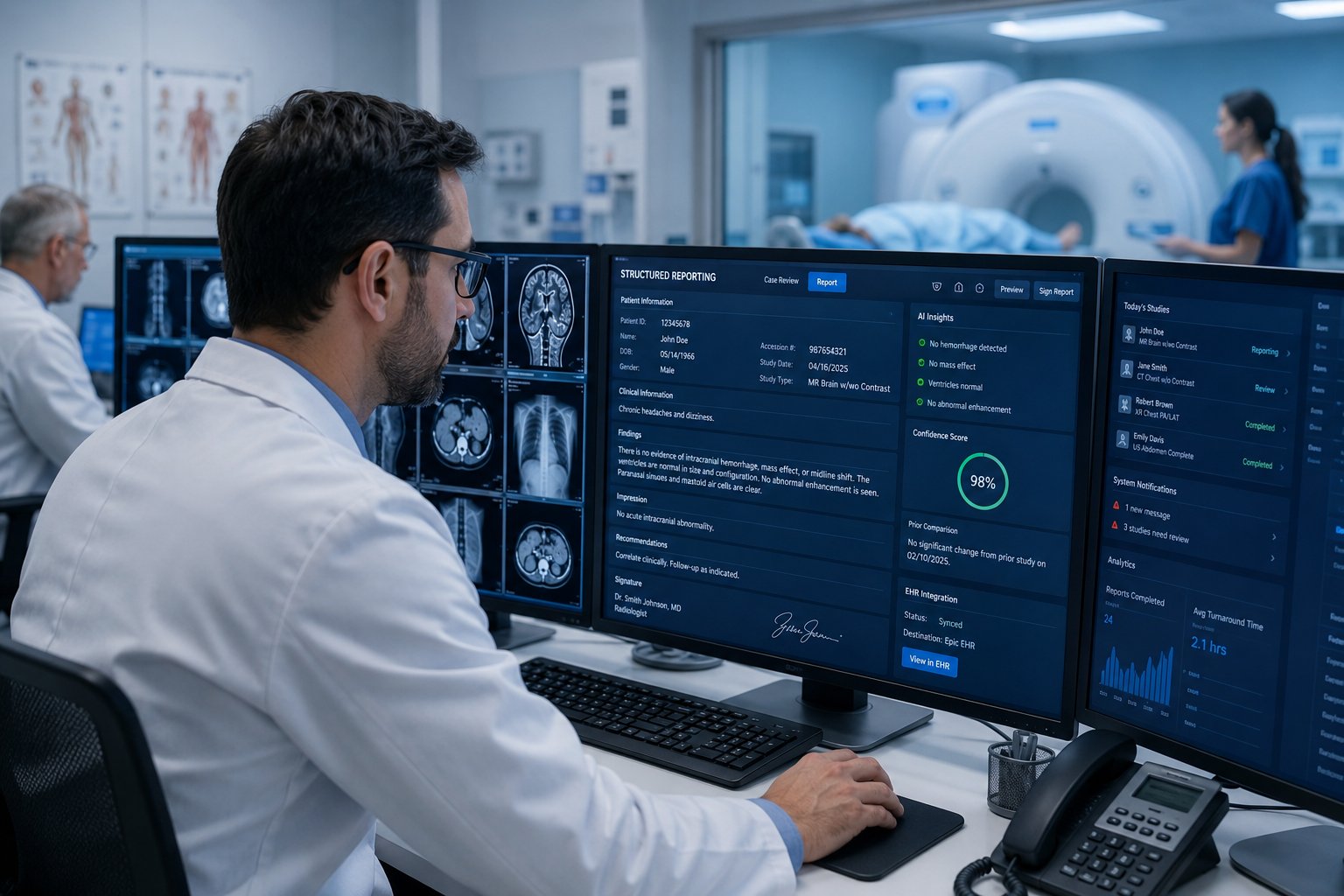
Healthcare organizations today rely heavily on accurate diagnostic documentation to ensure effective patient care. In radiology departments, every imaging interpretation must be documented clearly, consistently, and quickly. This is where structured radiology reporting becomes essential. Hospitals, imaging centers, and healthcare providers increasingly depend on Radiology Report Transcription, Radiology Reporting Services, and Radiology Report Formatting Services to maintain quality documentation standards and improve workflow efficiency.
Structured radiology reporting refers to the use of standardized templates and organized formats while documenting radiology findings. Instead of free-form narrative reports, structured reporting ensures consistency in language, formatting, terminology, and clinical information. This improves communication between radiologists, physicians, and healthcare teams while enhancing patient safety and treatment planning.
In modern healthcare systems, accurate Radiology Medical Record Documentation is critical for compliance, patient care continuity, insurance claims, and legal protection. Structured reporting helps eliminate ambiguity and reduces reporting errors, making it easier for physicians to interpret imaging findings quickly.
Structured radiology reporting is the process of creating radiology reports using predefined templates, headings, and organized clinical data fields. Reports are generally divided into sections such as:
Unlike traditional narrative reports, structured reports maintain uniformity across all imaging studies. This consistency allows physicians to locate important clinical information more efficiently.
Healthcare providers using professional Radiology Reporting Services benefit from improved report clarity, faster turnaround time, and better integration with Electronic Health Records (EHR) systems.
Structured radiology reporting plays a major role in improving communication and clinical accuracy. Radiologists often deal with large volumes of imaging studies daily, including CT scans, MRI scans, ultrasound reports, mammography reports, and X-rays. Without standardized formatting, reports can become inconsistent and difficult to interpret.
Professional Radiology Report Formatting Services help radiology departments maintain standardized documentation while reducing administrative burden.
Key Benefits Include:
Accurate Radiology Report Transcription is the backbone of structured reporting systems. Skilled transcription professionals convert dictated radiology findings into well-organized reports while maintaining medical terminology accuracy.
Radiologists often dictate reports quickly due to heavy workloads. Transcription specialists ensure that these reports are properly formatted, grammatically correct, and clinically accurate before submission to physicians or EHR systems.
High-quality transcription services also help eliminate common reporting problems such as:
Healthcare providers partnering with reliable Radiology Reporting Services can improve operational efficiency while maintaining documentation quality.
Consistency in radiology documentation is extremely important in healthcare environments. Different radiologists may use different reporting styles, which can sometimes create confusion among referring physicians.
This standardization improves communication between departments and supports better patient management decisions.
Accurate Radiology Medical Record Documentation also supports legal compliance and insurance reimbursement processes.
Structured reporting is widely used across several diagnostic imaging specialties.
| Imaging Modality | Purpose of Structured Reporting | Benefits |
|---|---|---|
| CT Scan Reports | Standardized findings and impressions | Faster interpretation |
| MRI Reports | Consistent neurological or musculoskeletal documentation | Improved diagnostic clarity |
| Ultrasound Reports | Organized anatomical findings | Better physician communication |
| Mammography Reports | BI-RADS standardized classification | Improved breast cancer screening |
| X-Ray Reports | Uniform trauma and chest findings | Reduced reporting errors |
| Nuclear Medicine Reports | Accurate imaging interpretation | Enhanced compliance |
Professional Radiology Report Formatting Services help healthcare providers maintain consistency across all imaging modalities.
One of the biggest advantages of structured radiology reporting is improved patient care. Clear and organized reports help physicians make faster and more accurate treatment decisions.
For example, when radiology findings are documented consistently, referring doctors can quickly identify:
Structured reports also reduce the chances of overlooked details or incomplete impressions. Accurate Radiology Medical Record Documentation ensures that patient records remain comprehensive and accessible across healthcare systems.
Radiology departments often manage hundreds of imaging studies every day. Without standardized reporting systems, documentation delays can negatively impact patient care and operational productivity.
Professional Radiology Reporting Services improve workflow by:
Structured reporting also allows healthcare facilities to analyze reporting data more effectively for quality improvement initiatives.
Formatting plays a critical role in report readability and usability. Proper formatting ensures that physicians can quickly identify critical findings and impressions.
Reliable Radiology Report Formatting Services help healthcare organizations maintain:
Well-formatted reports reduce confusion and improve physician satisfaction.
Despite its advantages, structured radiology reporting can present some challenges.
Common Challenges Include:
However, partnering with experienced Radiology Reporting Services providers can simplify implementation and ensure smoother transitions.
The future of radiology reporting is rapidly evolving with advancements in healthcare technology. Artificial intelligence, voice recognition software, and automated reporting tools are increasingly being integrated into radiology workflows.
Future trends include::
Even with advanced automation, human-reviewed Radiology Report Transcription remains essential for ensuring accuracy and compliance.
Pro Tip:
Healthcare organizations can significantly improve reporting accuracy and turnaround time by combining structured templates with professional Radiology Report Formatting Services and expert transcription support. Regular quality audits and standardized terminology usage further enhance documentation consistency and physician satisfaction.
Healthcare providers choose outsourced reporting solutions because they offer:.
Future trends include::
Professional Radiology Medical Record Documentation services help reduce physician workload while maintaining high documentation standards..
Structured radiology reporting has become an essential component of modern healthcare documentation. By improving report consistency, reducing errors, and enhancing physician communication, structured reporting supports better patient outcomes and operational efficiency.
Accurate Radiology Report Transcription, professional Radiology Reporting Services, and reliable Radiology Report Formatting Services help healthcare organizations maintain high-quality documentation standards while streamlining workflows.
As healthcare technology continues to evolve, structured reporting will play an even greater role in improving diagnostic accuracy, interoperability, and patient care delivery. Healthcare providers investing in quality Radiology Medical Record Documentation solutions can ensure better compliance, improved workflow management, and long-term operational success.
Structured radiology reporting uses standardized templates and organized sections to document imaging findings consistently and accurately.
Radiology Report Transcription ensures accurate conversion of dictated imaging findings into professionally formatted reports for clinical use.
Radiology Reporting Services reduce turnaround time, improve report accuracy, and streamline communication between radiologists and physicians.
Radiology Report Formatting Services standardize report layouts, headings, and terminology to improve readability and compliance.
Radiology Medical Record Documentation supports patient care continuity, legal compliance, insurance claims processing, and accurate clinical decision-making.