

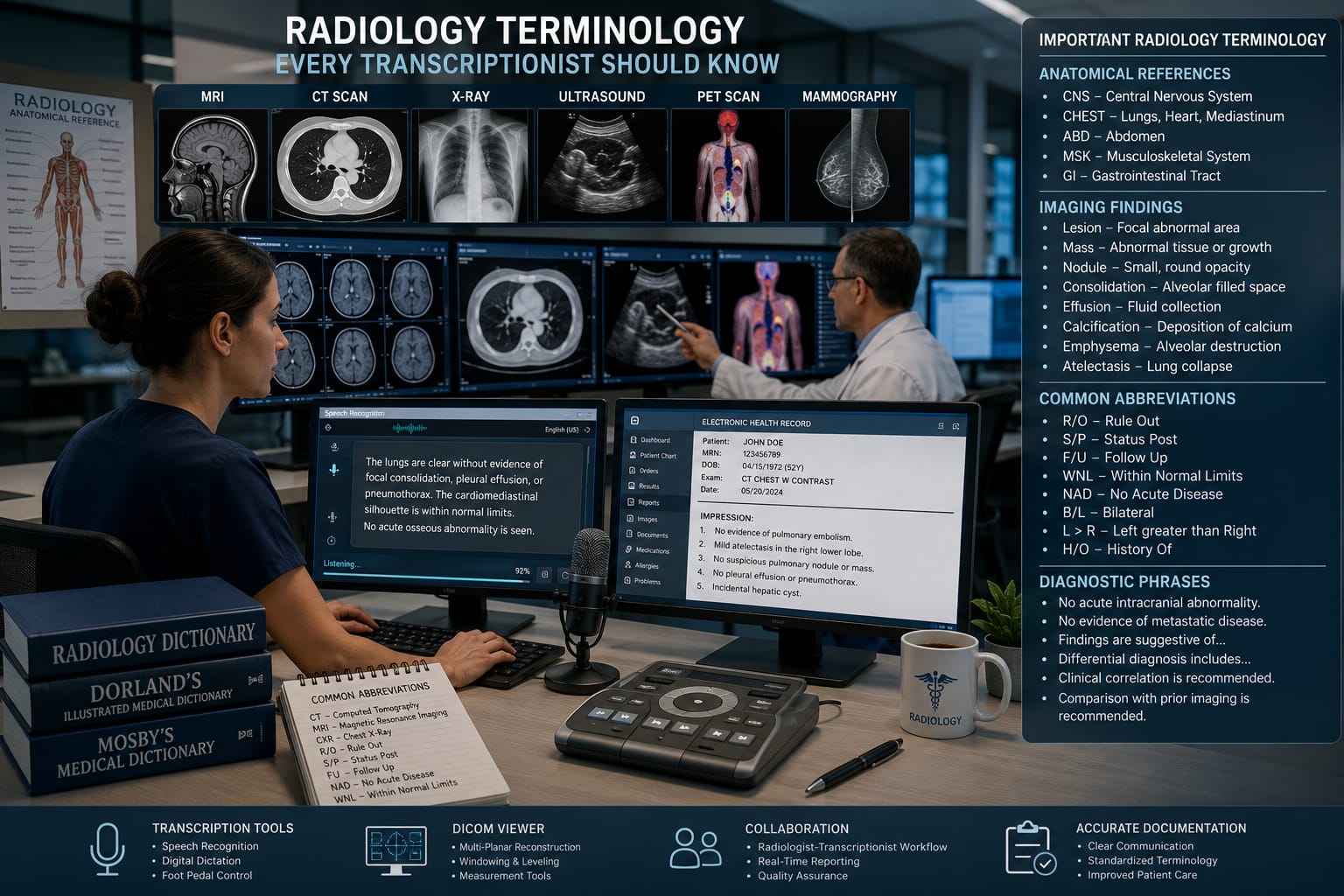
Understanding Radiology Terminology is essential for professionals working in medical documentation and healthcare reporting. Accurate terminology knowledge helps transcriptionists create clear, precise, and error-free radiology reports. In the healthcare industry, reliable Radiology Transcription Services and Radiology Reporting Services play a major role in supporting radiologists, hospitals, clinics, and diagnostic imaging centers.
Radiology transcriptionists convert dictated imaging reports into properly formatted medical documents. Since radiologists often use highly technical language and fast dictation speeds, transcriptionists must understand anatomy, imaging procedures, disease terminology, and diagnostic findings. Accurate transcription improves communication between healthcare providers and supports better patient care.
Radiology reports are used to diagnose diseases, evaluate injuries, and monitor patient conditions. A small terminology mistake can affect diagnosis and treatment decisions. This is why strong knowledge of Radiology Terminology is extremely important in professional Radiology Transcription Services.
Medical transcriptionists should understand:
Professionals providing Radiology Reporting Services rely on accurate terminology to deliver high-quality reports with fast turnaround time and proper formatting.
X-rays are commonly used to evaluate fractures, chest infections, and bone conditions. Frequently used terms include opacity, fracture, alignment, and consolidation.
Computed Tomography creates detailed cross-sectional images of the body. Common CT terminology includes:
MRI provides detailed images of soft tissues, organs, and nerves. Common MRI terms include:
Ultrasound uses sound waves to evaluate internal organs and blood flow. Frequently used terms include:
Comprehending imaging modalities lowers documentation errors and enhances the quality of Radiology Reporting Services.
Radiology reports describe the exact location of findings using anatomical directions. Every transcriptionist should understand these terms clearly.
Accurate interpretation of anatomical terminology is important for successful Radiology Transcription Services.
Radiologists commonly use descriptive medical terms during dictation. Every transcriptionist should recognize these terms.
An abnormal area of tissue identified on imaging.
An abnormal growth that may require additional evaluation.
Calcium deposits visible on imaging studies.
Swelling caused by excess fluid.
Fluid accumulation within a body cavity.
Protrusion of tissue or an organ through an opening.
Abnormal narrowing of a vessel or canal.
These terms are commonly used in Radiology Reporting Services across multiple imaging specialties.
Clear communication is essential in healthcare documentation. Radiology reports help radiologists communicate imaging findings with physicians, surgeons, and specialists. A correctly transcribed report guarantees that clinical data is precise, well-structured, and simple to comprehend.
Healthcare providers depend on professional Radiology Transcription Services to maintain documentation quality. Accurate reports support faster diagnosis, improved treatment planning, and better patient management. Whether identifying fractures, tumors, infections, or internal bleeding, every word in a radiology report has clinical importance.
Strong knowledge of Radiology Terminology helps transcriptionists minimize errors and improve report clarity.
Modern healthcare facilities rely heavily on professional Radiology Reporting Services to maintain organized and efficient documentation workflows. Standardized reports improve communication between radiologists and physicians while helping healthcare providers review patient findings quickly.
A standard radiology report usually includes:
Consistent formatting improves workflow efficiency and reduces confusion during clinical evaluation.
Healthcare organizations benefit greatly from experienced Radiology Transcription Services. Skilled transcriptionists provide accurate medical documentation while reducing administrative workload for radiologists.
Key benefits include:
Professional transcription services help healthcare facilities maintain accurate records and improve communication among medical teams.
Radiology transcription can be challenging because radiologists often dictate reports quickly using complex medical terminology. Common challenges include:
Continuous learning and listening practice help professionals improve performance in Radiology Reporting Services.
Technology has significantly improved healthcare documentation workflows. Speech recognition software and digital dictation systems help radiologists generate reports quickly. Nonetheless, human transcriptionists are still necessary for examining reports and fixing formatting, grammar, punctuation, and terminology mistakes.
Complex medical terminology may be misinterpreted by automated systems. Skilled transcriptionists in Radiology Transcription Services make sure that reports are accurate, comprehensive, and clinically significant.
The radiology field continues evolving with advanced imaging technologies and updated diagnostic procedures. Transcriptionists must continuously improve their medical vocabulary and stay updated on new terminology.
Learning anatomy, imaging procedures, and advanced radiology concepts helps professionals remain competitive in Radiology Reporting Services. Continuous education improves transcription quality and supports long-term career growth in healthcare documentation.
Understanding Radiology Terminology is essential for every medical transcriptionist involved in diagnostic imaging documentation. Knowledge of imaging modalities, anatomy terms, descriptive findings, and radiology abbreviations helps transcriptionists create accurate and professional reports.
Reliable Radiology Transcription Services and Radiology Reporting Services improve communication between healthcare providers, support accurate diagnosis, and contribute to better patient care. By continuously improving terminology knowledge and transcription skills, professionals can build successful careers in the growing radiology documentation industry.
Radiology terminology includes medical terms used in imaging reports and diagnostic documentation.
It helps transcriptionists create accurate and error-free radiology reports.
These services convert radiologist dictations into professionally formatted medical reports.
They include transcription, editing, formatting, and management of radiology reports.
They can improve through anatomy study, listening practice, and continuous medical education.